Every medic has a call they do not talk about. Usually more than one. The pediatric code on a Tuesday afternoon. The rollover on I-70 in a snowstorm. The address you have been sent to so many times you know which stair creaks.
The job trains you to set those calls down and get back in the truck. For a while that works. Over years, for a lot of people, it stops working. Sleep goes first. Then patience. Then the feeling of being present at your own kitchen table.
A federal review estimated that about 30 percent of first responders develop behavioral health conditions such as depression and post-traumatic stress disorder (PTSD).1 That is not a statement about toughness. It is what repeated exposure does to a human nervous system.
This article is for Colorado EMTs, paramedics, and firefighters, and the people who love them, who have heard about ketamine therapy and want straight answers.
Ketamine is a medication every paramedic already knows. It has been FDA-approved as an anesthetic since 1970, and many EMS agencies carry it.
In mental health care it is used very differently: at a much lower dose, given slowly through an IV, in a clinic, over about an hour. Used this way for depression, PTSD, or anxiety, ketamine is off-label. That means a licensed provider is prescribing an approved drug for a purpose outside its original approval. The only FDA-approved ketamine-based treatment for depression is esketamine (Spravato), a nasal spray.
Ketamine works on glutamate, a chemical messenger that most antidepressants do not touch. Researchers believe this helps explain why its effects, when they come, can come quickly.
You are trained to ask for evidence, so here it is, including the parts that are less flattering.
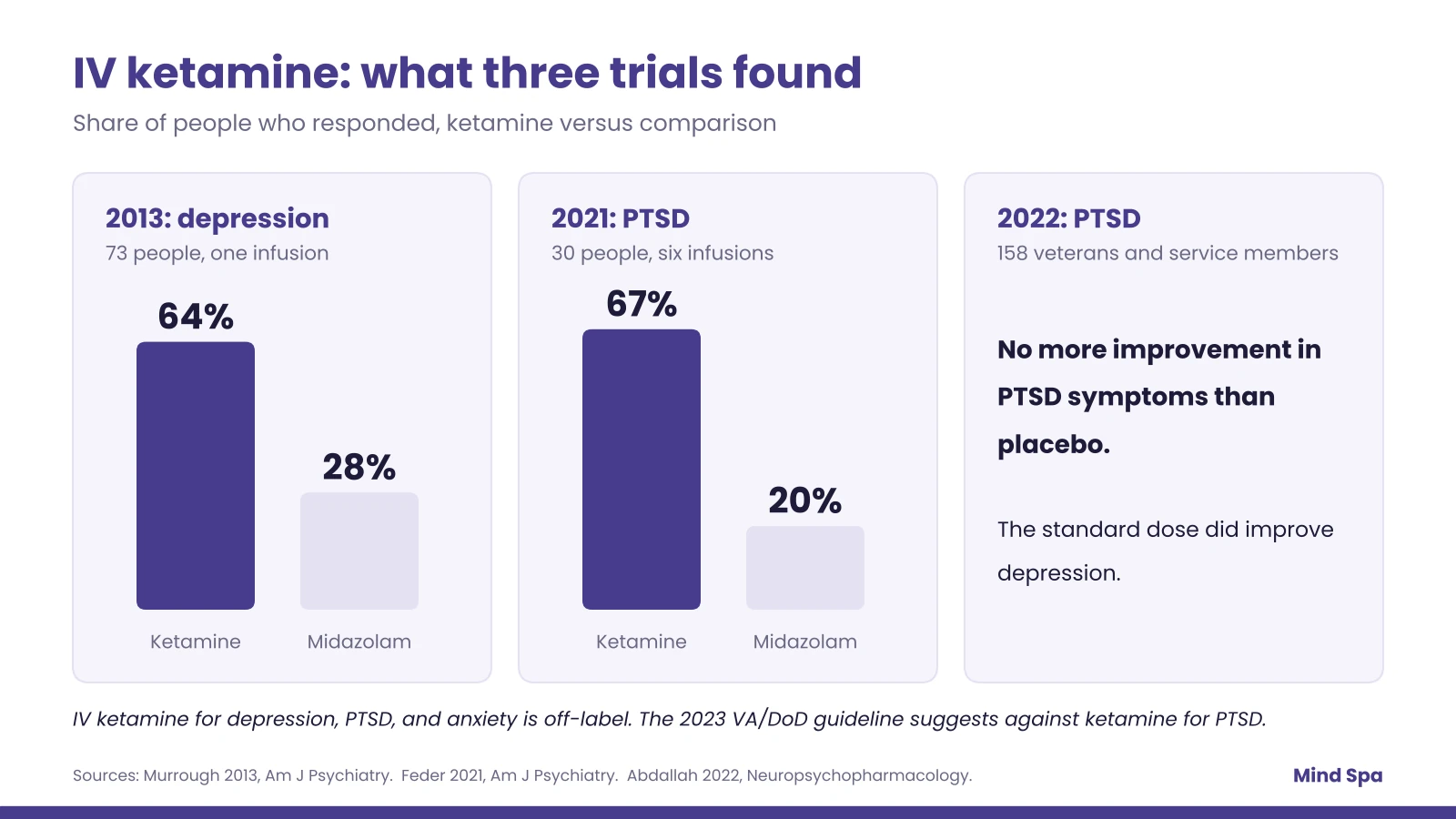
For depression, the evidence is strongest. In a 2013 trial at two hospitals, 73 people with treatment-resistant depression received a single infusion of either ketamine or midazolam, a sedative used as a comparison. A day later, 64 percent of the ketamine group had responded, compared with 28 percent of the midazolam group.2 The authors cautioned that more needed to be learned about how long the benefit lasts.
For PTSD, the results are mixed. A 2021 trial gave 30 people with chronic PTSD six infusions over two weeks. Sixty-seven percent of the ketamine group responded, compared with 20 percent of the comparison group, and among those who responded, the benefit lasted a median of about four weeks after the infusions ended.3 A larger 2022 trial in 158 veterans and service members found that ketamine did not reduce PTSD symptoms more than placebo, though the standard dose did improve depression.4
The 2023 guideline from the Department of Veterans Affairs and the Department of Defense suggests against ketamine as a treatment for PTSD itself.5
What that means in practice. At Mind Spa, ketamine is considered mainly for depression that has not improved enough with other treatment, including depression that travels with PTSD. It is not a first step, and it is not a replacement for trauma therapy.
Dillon Reid was a paramedic lieutenant with Platte Valley Ambulance Service when he came to Mind Spa. After years of hard calls, one in particular became his breaking point. What followed was dissociation and isolation, the kind that makes it hard to stay in the job or to be present at home. With the support of his fiancée, he asked for help.
Dillon has described his ketamine sessions as "productive every time." He says the treatment helped him stay in a profession where he makes a difference while also looking after himself.
Dillon's story is shared with his permission. It is one person's experience, not a typical result, and results vary from person to person.
If your picture of ketamine comes from the back of an ambulance, the clinic version will feel very different.
You check in and meet the nurse who will stay in the room with you, one-on-one, for the entire infusion. Your vital signs are taken. You lie back on a vibroacoustic sound table, which turns low-frequency sound into a gentle vibration you can feel, and the IV is started. The dose is based on your body weight.
The infusion runs 60 to 90 minutes. Some people feel calm. Many feel dissociation, a floating or dreamlike sense of being detached from the body. It can feel strange, and your nurse is there the whole time. Afterward, you can turn what you experienced into an image using artificial intelligence (AI) and bring it to your next therapy session, which gives you and your therapist somewhere to start.
A standard series is six infusions over two to three weeks. Plan for a ride home after each one.

During an infusion, the common side effects are dissociation, nausea, and a temporary rise in blood pressure. All of it is monitored.
First responders also ask about addiction, and it is a fair question. Ketamine is a controlled substance with real potential for misuse. At Mind Spa it is given only in the clinic, in measured doses, under medical supervision. It is never sent home with you. Tell your provider about your history with alcohol or other substances so that risk can be weighed properly.
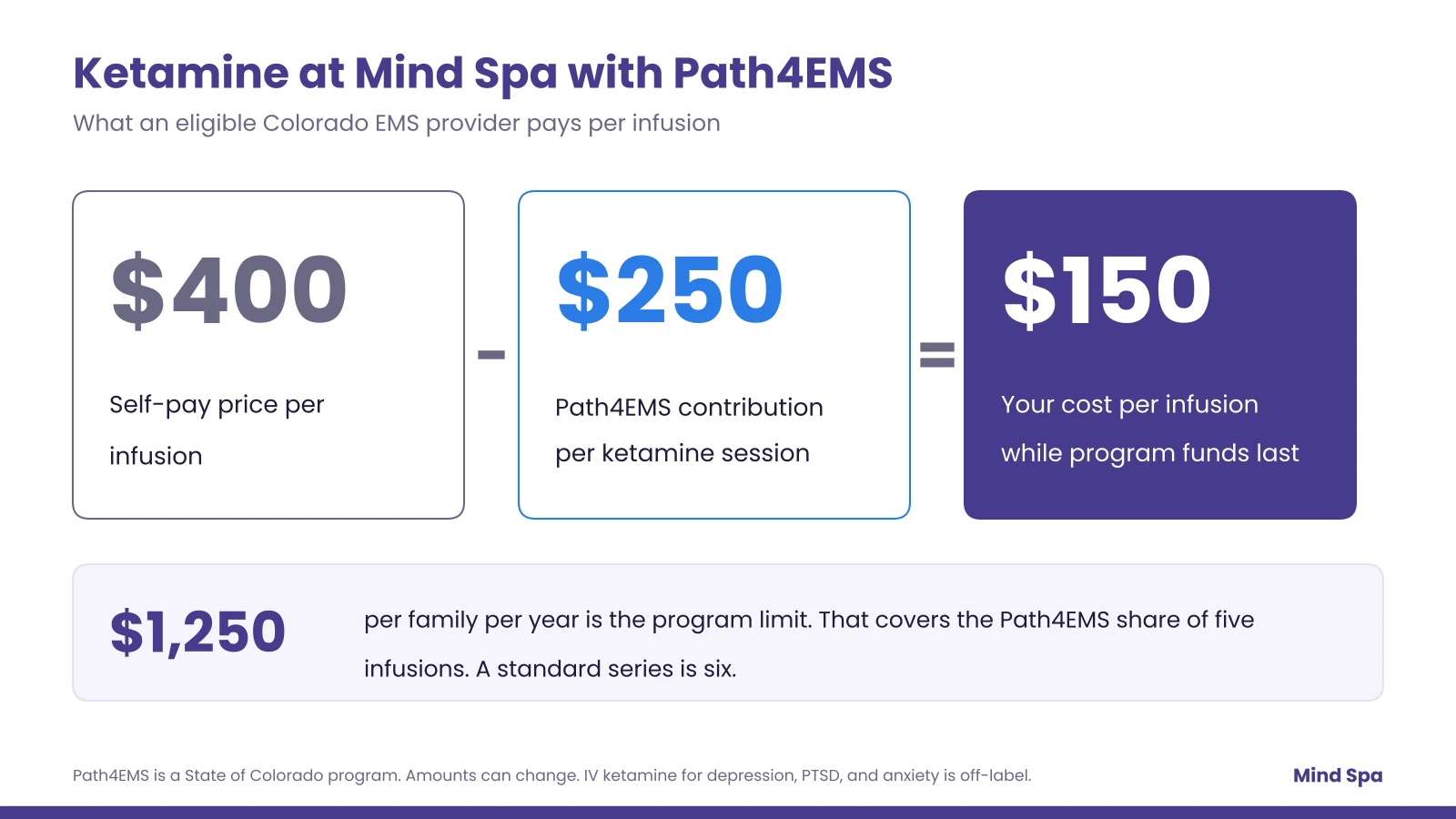
Insurance generally does not cover IV ketamine for mental health. Self-pay ketamine at Mind Spa is $400 per infusion.
Path4EMS is Colorado's confidential peer assistance program for EMS professionals, created by the state after 2019 legislation and overseen by the Colorado Department of Public Health and Environment.6 For eligible providers, the program currently contributes:
With the $250 contribution, an infusion costs you $150 out of pocket until the yearly limit is reached. The yearly limit covers the Path4EMS share of five infusions. We go over the exact numbers with you before you start, so there are no surprises.
To confirm your eligibility, Mind Spa shares your name, date of birth, and employer with Path4EMS.
If you hold a current Colorado EMS certification, whether you run calls in Brighton, Castle Rock, Lakewood, or a mountain district off US 285, ask us or ask Path4EMS whether you qualify.
Ketamine is not right for everyone. Care at Mind Spa begins with an evaluation that looks at your history, your medications, and what you have already tried. Sometimes the right answer is ketamine. Sometimes it is therapy, a medication change, or something else.
You look after strangers on the worst day of their lives. You are allowed to look after yourself. Learn more on our ketamine infusion page or our insurance page.
Mind Spa is at 5340 S Quebec St Ste 230S, Greenwood Village, CO 80111, just south of Denver with easy access from I-25 and I-225. We are open Monday to Friday, 9am to 5pm. Book A Consult or call 303-327-0350.
This article is for education and is not medical advice. IV ketamine is FDA-approved as an anesthetic; its use for depression, PTSD, and anxiety is off-label. Individual results vary and are not guaranteed. Path4EMS is a State of Colorado program; Mind Spa is an independent clinic and is not part of Path4EMS. Program amounts can change. Mind Spa is not a crisis service. If you are in crisis, call or text 988 (veterans, press 1).