Anyone who has flown into Denver and climbed a flight of stairs knows what thin air feels like. At a mile high, the air pressure is about 17 percent lower than at sea level, and every breath carries a little less oxygen with it.
Hyperbaric oxygen therapy (HBOT) runs that experiment in the other direction. You sit inside a sealed chamber, the pressure rises well above normal, and you breathe concentrated oxygen. For decades hospitals have used it for a short list of conditions like decompression sickness in divers. The newer question, and the one veterans and their families ask us about most, is whether it can help the brain after trauma.
Researchers have been testing that for more than ten years. The results are interesting, and they do not all point the same way. Here is where things stand.
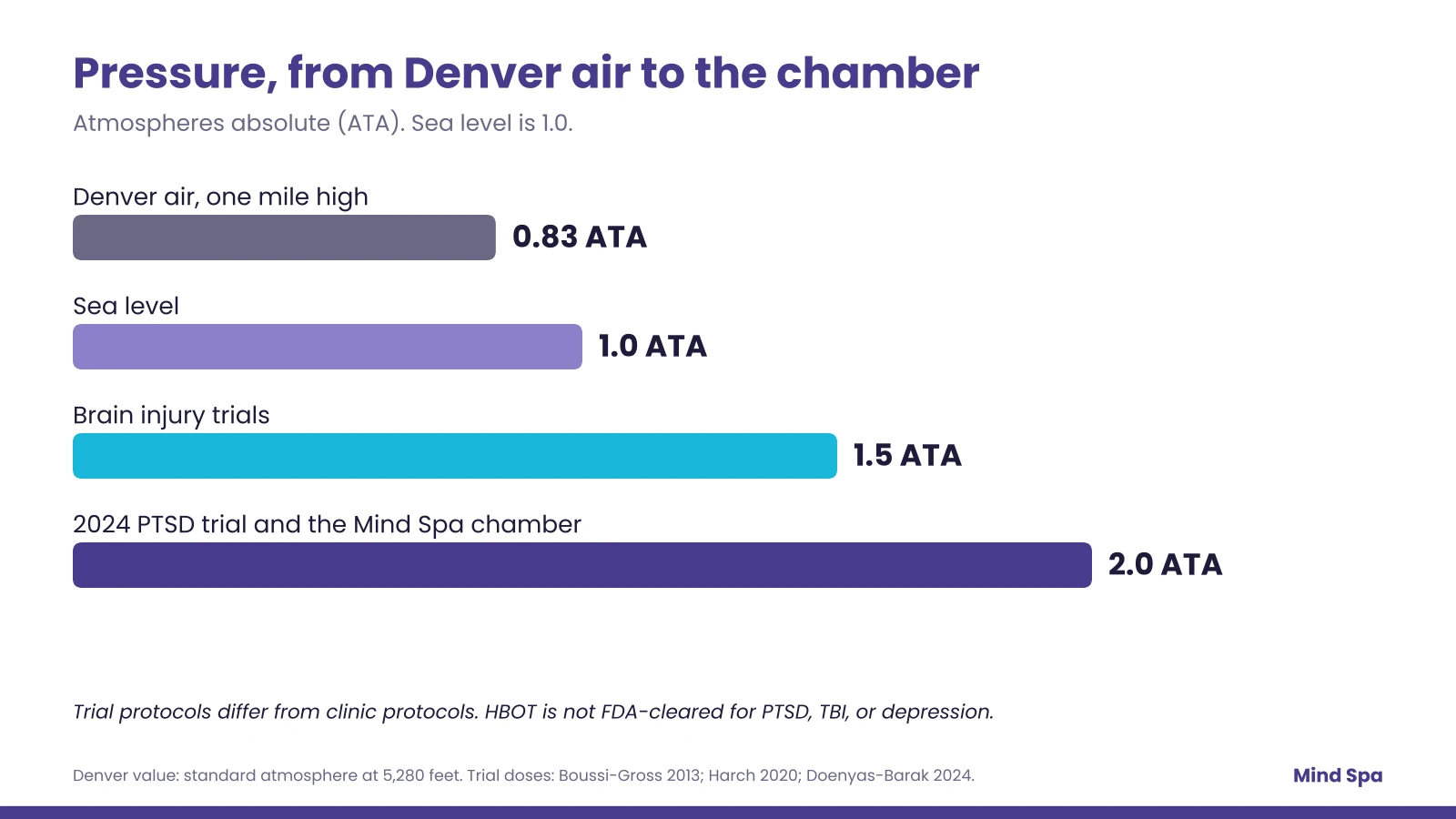
Pressure is measured in atmospheres absolute (ATA). Sea level is 1.0 ATA. Denver sits at about 0.83. A chamber set to 2.0 ATA doubles sea-level pressure.
Under that pressure, far more oxygen dissolves directly into the liquid part of your blood than breathing can deliver on its own. Scientists are studying what repeated sessions of that extra oxygen do to blood flow, inflammation, the tiny power plants inside cells called mitochondria, and neuroplasticity, the brain's ability to reorganize itself. Those are the proposed mechanisms. They come mostly from laboratory and imaging work, and they are the reason clinical trials were started, not a substitute for them.
The strongest single study so far for post-traumatic stress disorder (PTSD) was published in 2024 in The Journal of Clinical Psychiatry.1 Israeli researchers randomly assigned 63 male combat veterans, all of whom still had PTSD after therapy and medication, to either 60 sessions of HBOT at 2.0 ATA or a sham, a look-alike procedure without the active treatment. Fifty-six finished.
More veterans in the HBOT group improved than in the sham group, and their depression scores improved too. It was one trial, at one center, in men without a known brain injury. We covered it in detail in our article on that study.
The 2023 guideline from the Department of Veterans Affairs and the Department of Defense (VA/DoD) reviewed the field and found insufficient evidence to recommend for or against HBOT for PTSD.2
Traumatic brain injury (TBI) is where the research gets complicated, and where it helps to read the studies side by side.
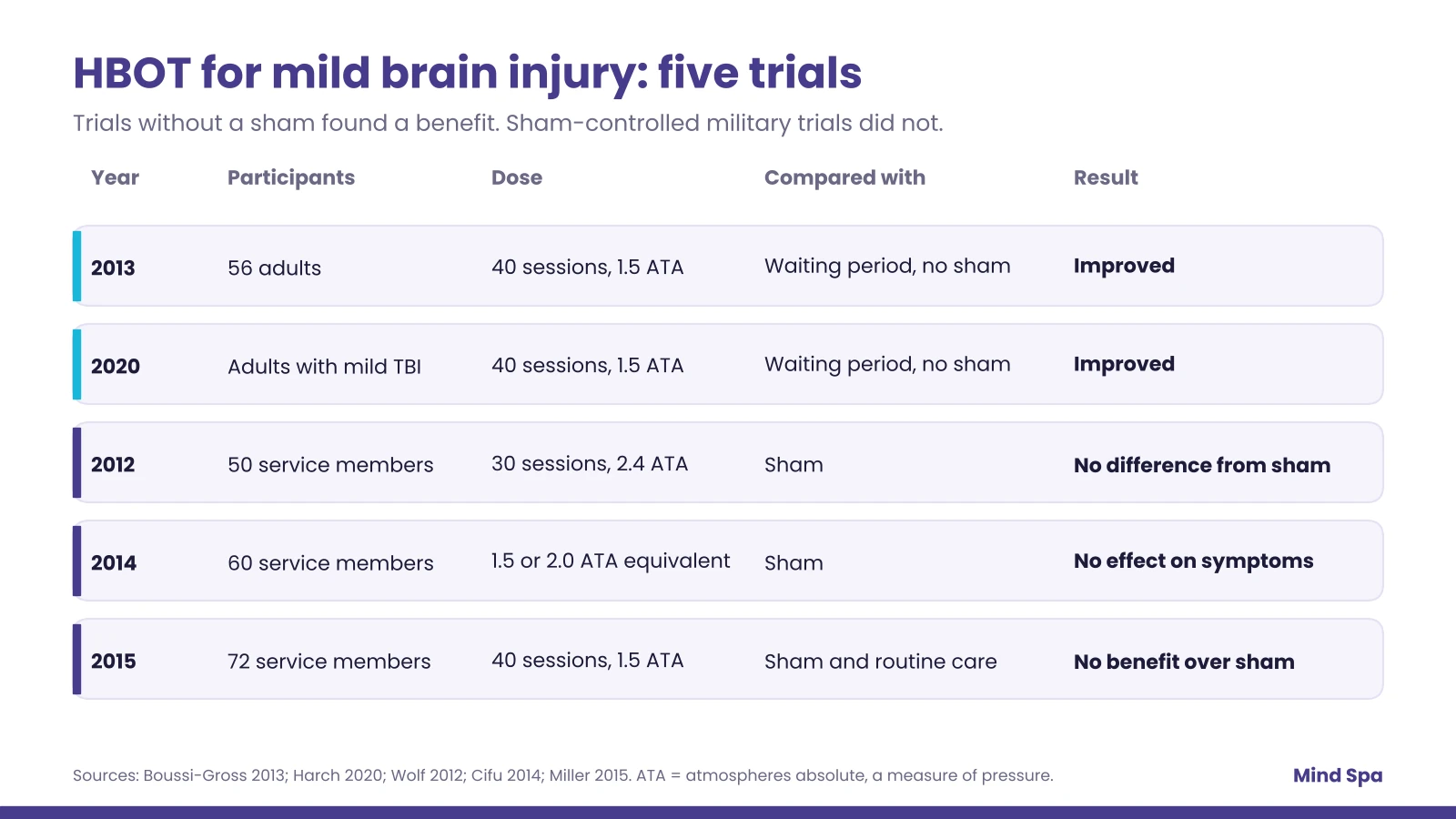
Trials that found a benefit. In 2013, an Israeli team studied 56 people who still had symptoms one to five years after a mild TBI.3 After 40 one-hour sessions at 1.5 ATA, they scored better on tests of thinking and quality of life. A 2020 American trial used the same dose, 40 sessions at 1.5 ATA, and reported improvements in post-concussion symptoms, memory, sleep, and mood.4 Both used a crossover design: one group waited without treatment and then received HBOT. Neither used a sham, so participants knew when they were being treated.
Military trials that did not. The Department of Defense ran its own studies in service members with combat-related mild TBI, and these did use shams.
How to read the disagreement. There are two ways to explain it, and experts argue for each. One is that the benefit in the unblinded trials came from expectation, daily structure, and attention, which is exactly what a sham is designed to catch. The other is that the shams were not inert: sitting in a mildly pressurized chamber may do something on its own, which would hide a real effect. Nobody has settled this. A person deciding about HBOT for a brain injury deserves to know that the question is open.
Depression has rarely been the main target of an HBOT trial. Most of what we know comes from PTSD and TBI studies that tracked mood along the way. Depression scores improved in the 2024 PTSD trial and in the 2020 TBI trial. Those are encouraging side findings. They are not the same as a trial designed to test HBOT for depression, and no one should start HBOT expecting it to treat depression on its own.
HBOT is generally well tolerated, and it is not risk-free. The most common problem is barotrauma, meaning ear or sinus pain or injury from the pressure change, the same feeling you get driving down from the Eisenhower Tunnel, only stronger. Some people notice temporary changes in vision after many sessions. Rarely, high oxygen levels can trigger a seizure. Tight spaces bother some people. A provider should review your ears, lungs, medications, and medical history before you start.
Mind Spa offers hyperbaric oxygen therapy in a 2.0 ATA hard-sided chamber, in sessions of 60 or 90 minutes, after a visit with one of our providers. HBOT is also part of our Inner Armor program, which includes 36 HBOT sessions alongside TMS and ketamine for eligible TRICARE Prime, Select, and Reserve Select beneficiaries. That is not the same protocol as any of the trials above, and we will not tell you it is.
If you are weighing HBOT, start with a conversation. A Mind Spa clinician will go through your history, what you have already tried, and what the evidence does and does not support for your situation.
Mind Spa is at 5340 S Quebec St Ste 230S, Greenwood Village, CO 80111, just south of Denver with easy access from I-25 and I-225. We are open Monday to Friday, 9am to 5pm. Book A Consult or call 303-327-0350.
This article is for education and is not medical advice. Hyperbaric oxygen therapy is not FDA-cleared for PTSD, TBI, depression, or anxiety; these uses are investigational. The hyperbaric chamber at Mind Spa is not an FDA-cleared medical device. Individual results vary and are not guaranteed. Mind Spa is an independent clinic in network with TRICARE West and is not affiliated with or endorsed by TRICARE, the Defense Health Agency, or the Department of Veterans Affairs. Nonprofit partner funding may be available for ketamine infusions and HBOT sessions in Inner Armor. It depends on your insurance plan and individual eligibility and is not guaranteed. Mind Spa is not a crisis service. If you are in crisis, call or text 988 (veterans, press 1).