For a lot of combat veterans, PTSD does not end when treatment does. They have done the trauma-focused therapy. They have taken the medications, sometimes several of them. And the symptoms are still there: the nightmares, the hair-trigger startle, the distance from the people they love.
That group, veterans who did the standard work and are still struggling, is exactly who a team of Israeli researchers set out to study. In 2024, The Journal of Clinical Psychiatry published their randomized, sham-controlled trial of hyperbaric oxygen therapy (HBOT) for combat-related post-traumatic stress disorder (PTSD). Because it is one of the more carefully designed HBOT studies for PTSD so far, the details matter, including the ones that rarely make the headlines.
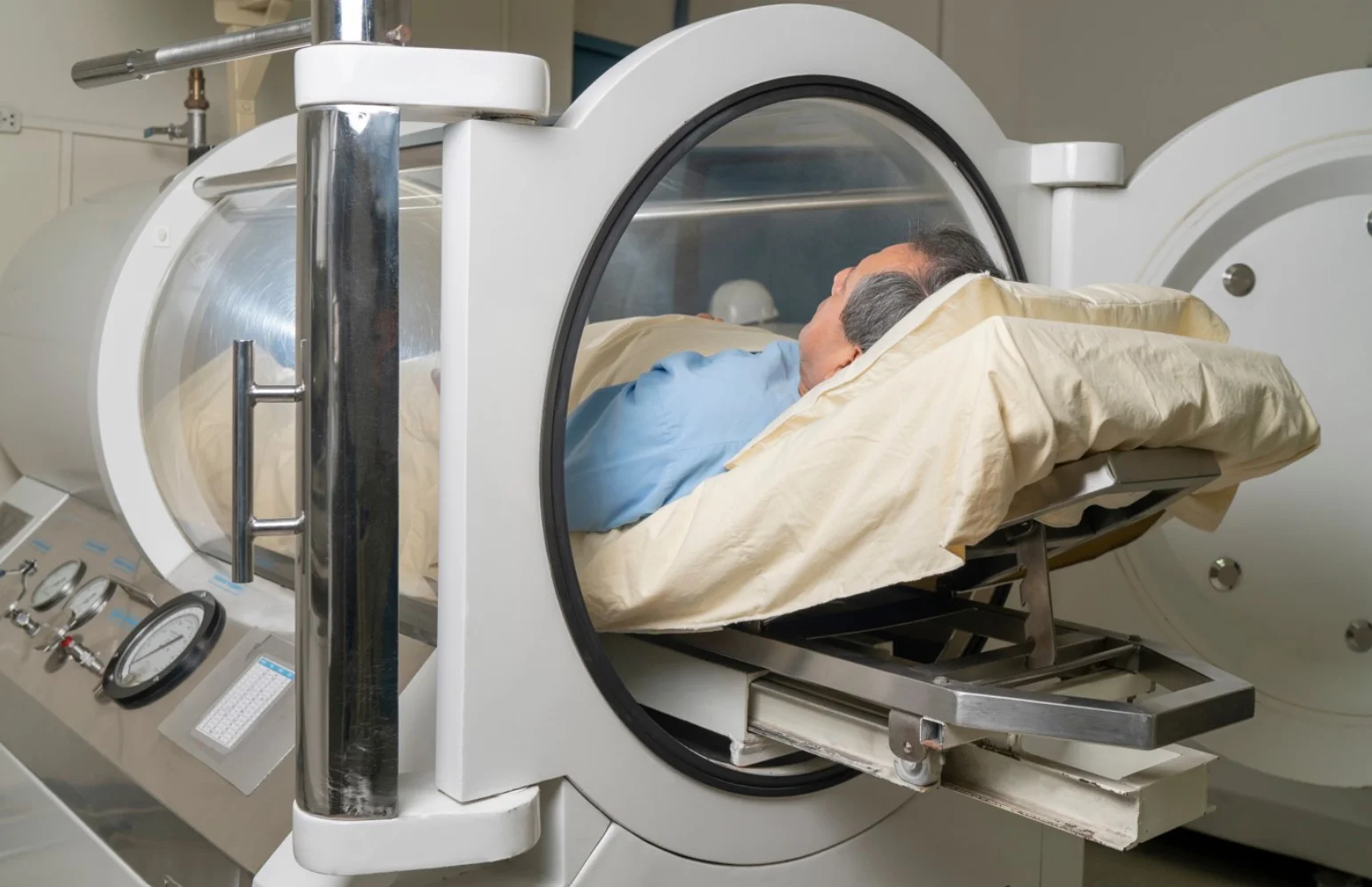
Hyperbaric oxygen therapy means breathing concentrated oxygen while inside a chamber pressurized above normal air pressure. That pressure is measured in atmospheres absolute (ATA). At sea level you live at 1.0 ATA; a 2.0 ATA chamber doubles it. Under that pressure, far more oxygen dissolves into the blood than breathing alone can deliver.
Researchers are studying how those repeated swings in oxygen affect blood flow, inflammation, and neuroplasticity, the brain's ability to reorganize itself. That is the biological case for testing HBOT in PTSD, which emerging research links to changes in brain activity and structure.
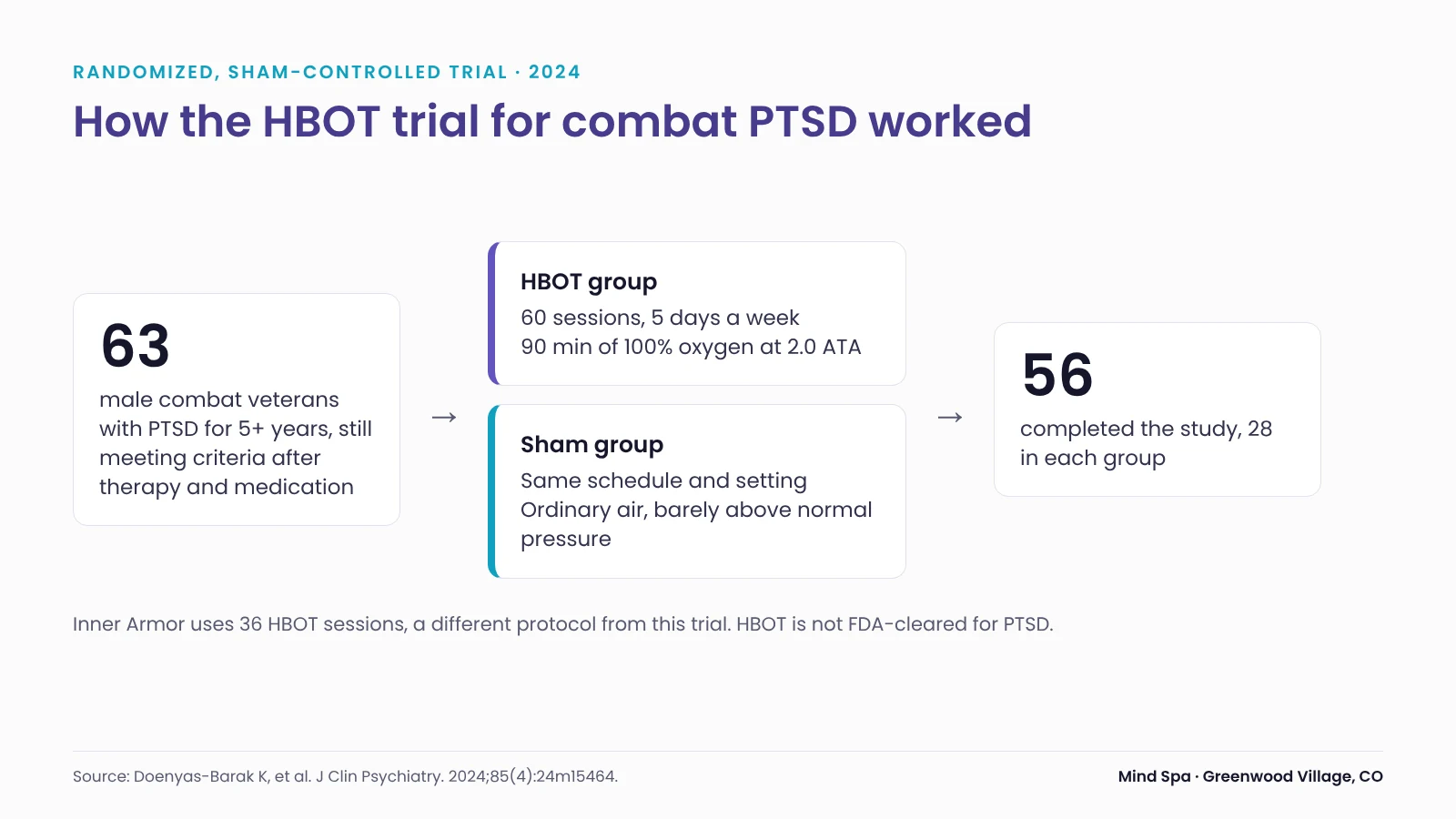
The study ran at the Sagol Center for Hyperbaric Medicine and Research at Shamir Medical Center in Israel, from February 2020 to July 2023. The researchers enrolled male veterans between 25 and 60 years old whose combat-related PTSD had lasted at least five years. None had a known traumatic brain injury. Every one of them had already been through at least one course of trauma-focused psychotherapy and medication and still met the full criteria for PTSD.
Sixty-three veterans were randomly assigned to one of two groups, and 56 completed the study, 28 in each.
The HBOT group came in five days a week for 60 sessions. Each session was 90 minutes of 100 percent oxygen at 2.0 ATA, with a five-minute air break every 20 minutes.
The other group received a sham: a look-alike procedure in the same setting that does not deliver the active treatment. They spent the same time in the chamber breathing ordinary air at barely above normal pressure. A sham only works if people cannot tell the difference, and this one held up. In both groups, about two out of three participants believed they were getting the real thing.
More veterans in the HBOT group improved, and more reached remission, than in the sham group, and the difference was statistically significant. Depression scores improved as well. Measures of anxiety and stress did not show a significant difference.
The team also scanned participants' brains. Resting-state functional MRI, a scan that tracks how different brain regions communicate while a person is at rest, showed stronger connectivity in the HBOT group after treatment. The authors read that as a biological change running alongside the clinical one.
The trial reported mostly mild side effects. The authors advise clinicians to watch for mild barotrauma, meaning ear or sinus injury from pressure changes, and for difficult memories surfacing during treatment. Any veteran considering HBOT should hear about both before starting.
This is one trial, and a small one. It studied men only, all without a known brain injury, at a single center. The protocol was intensive: 60 sessions over roughly three months. The authors are explicit that their results apply to the protocol they tested and should not be stretched to other pressures, schedules, or non-medical chambers.
It also lands in a field where the official guidance is still catching up. The Defense Health Agency's Psychological Health Center of Excellence notes that the VA/DoD clinical practice guideline found insufficient evidence to recommend for or against HBOT for PTSD. A well-designed trial moves that conversation forward, but one study rarely changes a guideline on its own.
If you love someone living with PTSD, you already know it reaches the whole household. Knowing that serious researchers are testing new options, and publishing careful results, can be a real source of hope.
Hope is a good reason to ask questions. Ask them of a clinician who knows the veteran's full history. HBOT is used off-label for PTSD, it carries real risks, and it is not right for everyone.
In Colorado, that conversation might start with your team at VA Eastern Colorado, at the Rocky Mountain Regional VA Medical Center in Aurora or a community clinic closer to home, or with a civilian provider along the Front Range. Bring this trial with you.
Mind Spa offers hyperbaric oxygen therapy at our Greenwood Village clinic, just south of Denver, in a hard-sided chamber at 2.0 ATA, in sessions of 60 or 90 minutes. For eligible TRICARE Prime, Select, and Reserve Select beneficiaries and their families, HBOT is part of our Inner Armor program, which runs 36 HBOT sessions alongside TMS and ketamine. That is a different protocol from the one tested in this trial, and we say so up front. A Mind Spa clinician reviews your history and your treatment so far before recommending whether HBOT makes sense for you. Learn more about care for veterans at Mind Spa.

Mind Spa is at 5340 S Quebec St Ste 230S, Greenwood Village, CO 80111, just south of Denver with easy access from I-25 and I-225. We are open Monday to Friday, 9am to 5pm. Book A Consult or call 303-327-0350.
Hyperbaric oxygen therapy is not FDA-cleared for PTSD, TBI, depression, or anxiety; these uses are investigational. Individual results vary and are not guaranteed. Mind Spa is an independent clinic in network with TRICARE West. Mind Spa is not affiliated with or endorsed by TRICARE, the Defense Health Agency, or the Department of Veterans Affairs. Ketamine infusions and HBOT sessions in Inner Armor are funded for eligible Inner Armor patients through Mind Spa's nonprofit partners. Standard TRICARE copays and cost-shares apply to TMS and other TRICARE-covered care. We review your expected costs with you before you begin. Mind Spa is not a crisis service. If you are in crisis, call or text 988 (veterans, press 1).