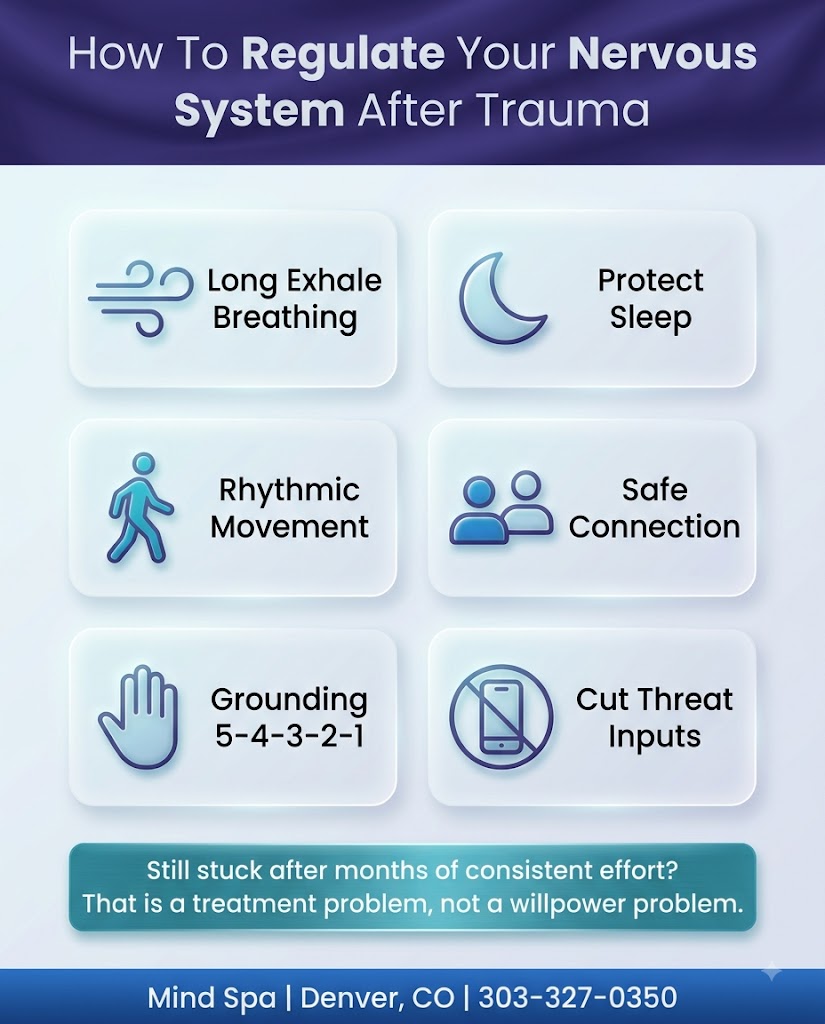
You regulate a traumatized nervous system from the bottom up: slow the breath, protect sleep, move the body, and use safe connection with other people. Practiced consistently, these shift the body out of threat mode. And when the system stays stuck because of underlying PTSD or a brain injury, that is not a willpower problem. It is a treatment problem, and treatments exist.
If you feel wired and exhausted at the same time, startle at nothing, cannot sit still in a restaurant unless your back is to the wall, or go from calm to furious in half a second, your nervous system is doing exactly what trauma trained it to do. Nothing about you is broken. A system built to keep you alive is still running its wartime settings in peacetime.
This guide covers what actually helps, in plain terms. It is written for the veterans and first responders we treat at Mind Spa in Denver, but the biology is the same for anyone carrying trauma, including trauma from childhood.
Your autonomic nervous system is the part of your nervous system that runs automatically: heart rate, breathing, digestion, blood pressure. It has two main branches. The sympathetic branch is the accelerator, mobilizing you for fight or flight. The parasympathetic branch is the brake, returning you to rest, digestion, and recovery.
In a healthy system, the two branches trade off fluidly. Stress comes, the accelerator fires, the threat passes, the brake brings you back down. Trauma disrupts that trade-off. After enough danger, or danger severe enough, the system recalibrates toward survival: the accelerator becomes the default, the brake becomes hard to find, and the brain's threat detector, the amygdala, starts flagging neutral things as dangerous. That recalibrated state is what people mean by a dysregulated nervous system.
Common signs include:
Breathing is the one autonomic function you can steer manually, which makes it a direct line to the brake. Slow breathing with a long exhale has been associated with increased parasympathetic activity. A simple version: inhale through the nose for four counts, exhale through the mouth for six to eight counts, for two to five minutes. Another well-studied pattern is the physiological sigh: two short inhales through the nose, one long exhale through the mouth. The technique is less important than the principle: exhale longer than you inhale, and do it daily, not just in crisis.
Sleep is when the brain processes emotional memory and resets stress hormones. Trauma attacks sleep first, which creates a loop: poor sleep raises reactivity, reactivity ruins sleep. Break the loop with boring discipline. Consistent wake time, even on weekends. Dark, cool room. No alcohol as a sleep aid, since alcohol fragments the second half of the night. Caffeine cut off by early afternoon. If nightmares or insomnia persist for months, tell a clinician, because both are treatable and neither is a personal failing.
Exercise metabolizes the stress chemistry your system keeps producing. Rhythmic, repetitive movement, such as walking, rucking, rowing, swimming, or cycling, has been studied for its calming effects on the stress response. Intensity has a place too: resistance training and hard conditioning give the mobilized energy somewhere to go. The rule is regularity over heroics. Thirty minutes most days beats two hours once a week.
Human nervous systems regulate each other. This is called co-regulation, and it is why isolation makes everything worse and why being around one person you trust can settle you when nothing else does. It does not require talking about the trauma. Working out with a buddy, coffee with someone who served, sitting in the same room as your family counts. For many of the veterans and first responders we see, isolation was the accelerant. Connection is the counterweight.
When the system spikes, grounding techniques pull attention out of the alarm and into the present through the senses. A common one is 5-4-3-2-1: name five things you can see, four you can feel, three you can hear, two you can smell, one you can taste. Cold water on the face or hands is another fast physical reset. These are circuit breakers, not cures. They end an episode. The practices above change the baseline.
Stimulants, energy drinks, doomscrolling, and chronic sleep debt all push the same accelerator trauma already holds down. You do not have to become a monk. But if you are trying to convince your body the war is over while feeding it four energy drinks and three hours of combat footage a day, the body will believe the inputs.
Survival mode from childhood trauma deserves its own section, because it works differently than trauma acquired as an adult.
When trauma happens in childhood, whether abuse, neglect, chaos, or growing up around violence, the nervous system does not recalibrate from a settled baseline. It develops with threat as the baseline. Survival mode is not a state you entered. It may be the only state you have ever known, which is why it can feel like personality rather than adaptation. The adult version often looks like: inability to relax without guilt, constant scanning of other people's moods, overworking as safety, people-pleasing as defense, explosive reactions to small triggers, or choosing chaos because calm feels unfamiliar and therefore unsafe.
The way out uses every practice above, plus three additions:
Here is the honest part most articles skip.
Breathing, sleep, movement, and connection are real, and for many people they are enough to restore a workable baseline. But when trauma has produced clinical PTSD, or when it is compounded by traumatic brain injury (TBI), which is common in combat veterans and first responders, the dysregulation can be maintained by changes in brain function itself. In those cases, a person can do every technique in this article correctly and still be stuck. That is not failure. It is the point where self-help ends and medicine begins.
Signs you are past the self-help line:
Interventional psychiatry exists for exactly this situation. At Mind Spa our layered model combines treatments that approach the stuck nervous system from different angles:
The techniques in this article are not a substitute for that care, and that care is not a substitute for these techniques. They stack. Patients who build regulation habits during treatment keep tools for life.
If you are in crisis right now: call or text 988 for the Suicide and Crisis Lifeline. Veterans can press 1 or text 838255 for the Veterans Crisis Line. Regulation techniques are for daily life, not emergencies.
There is no fixed timeline. Consistent daily practice of breathwork, sleep discipline, movement, and connection typically shows effects over weeks to months, not days. If months of consistent effort produce no change in your baseline, that is a signal to get a clinical evaluation, not to try harder.
Hypervigilance, exaggerated startle, feeling wired but tired, fast anger, poor sleep, unexplained digestive issues, and emotional numbness or shutdown are the most common signs after trauma.
Many people meaningfully improve their baseline with consistent self-regulation practices. But when dysregulation is driven by clinical PTSD or traumatic brain injury, self-help alone is often not enough, and evidence-based treatments like therapy, TMS, and ketamine exist for that situation.
A nervous system that develops under threat builds threat in as its baseline. In adulthood that shows up as constant vigilance, inability to relax, people-pleasing, overworking, and reactivity. It is an adaptation that outlived its purpose, and it can be retrained.
Trauma-focused psychotherapy, medication management, TMS, ketamine infusion therapy, and hyperbaric oxygen therapy are used clinically for trauma-related conditions. TMS is covered by Tricare, the VA, and most major insurers for qualifying patients.
Mind Spa treats veterans, first responders, and their families. Trauma does not stop with the person who wore the uniform, and neither does care.
That is a treatable problem. Mind Spa treats PTSD, depression, anxiety, and TBI in veterans and first responders with Tricare, VA Community Care, and major commercial plans.
Book A ConsultOr call us directly: 303-327-0350
This article is educational and is not medical advice, diagnosis, or a treatment recommendation. Techniques described are general wellness practices; individual results vary. Treatment decisions at Mind Spa are made by our clinical team based on individual evaluation. If you are experiencing a mental health emergency, call or text 988.