There is a conversation we have often at Mind Spa. Someone has done the work. They finished a course of trauma therapy, or tried two or three medications for anxiety, and things are better but not better enough. Then a friend, a podcast, or a late-night search mentions transcranial magnetic stimulation (TMS), and they want to know one thing: does it work for what I have?
For depression, that question has a solid answer. For post-traumatic stress disorder (PTSD) and anxiety, the honest answer takes a little longer. Here it is.
TMS uses a magnetic coil, resting against the scalp, to send brief pulses into a targeted part of the brain. The pulses stimulate nerve cells in circuits involved in mood and fear. There is no surgery and no anesthesia. You are awake, and you can drive yourself home.
The Food and Drug Administration (FDA) first cleared a TMS device for major depressive disorder in 2008. Mind Spa uses the Apollo TMS Therapy System, which is FDA-cleared for major depressive disorder and obsessive-compulsive disorder (OCD). Using it for PTSD or anxiety is off-label, meaning a licensed provider prescribes it for a condition outside the device's clearance.
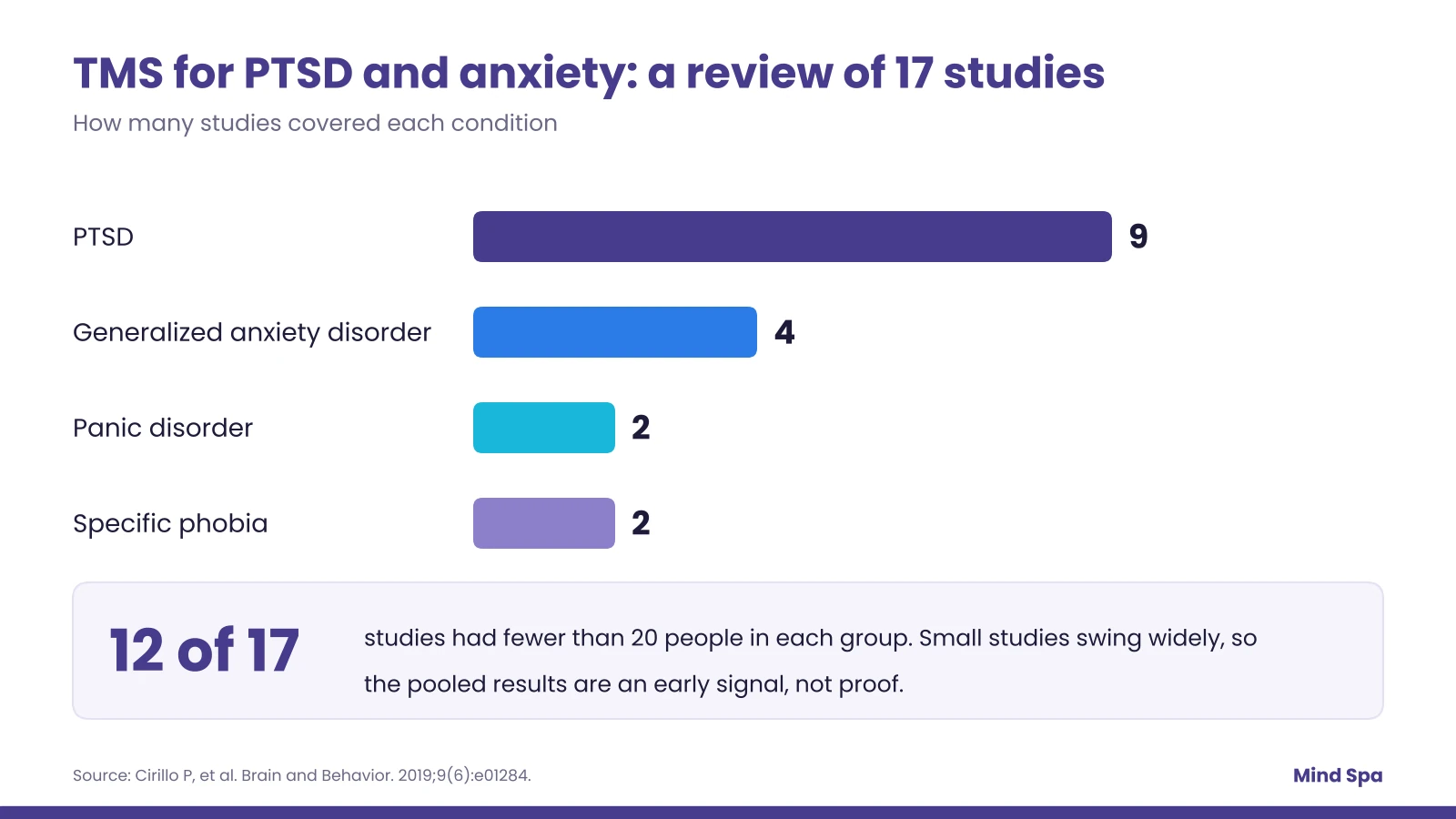
In 2019, a team that included researchers from Massachusetts General Hospital and Harvard Medical School gathered every study it could find on TMS for anxiety and trauma-related disorders.1 Out of 520 papers screened, 17 met their standards: nine in PTSD, four in generalized anxiety disorder (GAD), two in panic disorder, and two in specific phobia.
They pooled the PTSD and GAD results into a meta-analysis, a method that combines several small studies into one larger estimate. Results are reported as an effect size, a number that describes how far the treated group moved compared with the comparison group. By convention, 0.5 is medium and 0.8 is large.
Those are big numbers. They are also the reason this topic gets written about with so much excitement, and why it pays to read past the headline.
The authors were direct about the limits of their own review.
Twelve of the 17 studies had fewer than 20 people in each group. Small studies swing widely. One of the GAD studies reported that every patient in its active group was in remission a month later, which sounds remarkable until you learn the group was 15 people.
Not every study used a sham, the look-alike procedure that tells you how much improvement comes from attention and expectation alone. Of the four GAD studies, two had no sham group at all. The studies also aimed at different brain targets, used different pulse settings, and measured results in different ways. The authors wrote that these differences make the results hard to generalize, and that few studies reported side effects in enough detail to judge safety well.
So the fair reading is this: the early signal is real and worth pursuing, and it is not yet proof.
Two official positions are worth knowing.
The first is the clinical practice guideline that the Department of Veterans Affairs and the Department of Defense (VA/DoD) updated in 2023.2 It found insufficient evidence to recommend for or against repetitive TMS for PTSD. Its strongest recommendations went to three trauma-focused talk therapies: prolonged exposure, cognitive processing therapy, and eye movement desensitization and reprocessing (EMDR).
The second is newer. In June 2026, the FDA cleared the first TMS-based system for PTSD, called MeRT, as an add-on treatment for adults.3 It uses a recording of the patient's brain waves to set the stimulation. That clearance applies to that system and its protocol. It does not extend to standard TMS, and Mind Spa does not offer MeRT at this time.
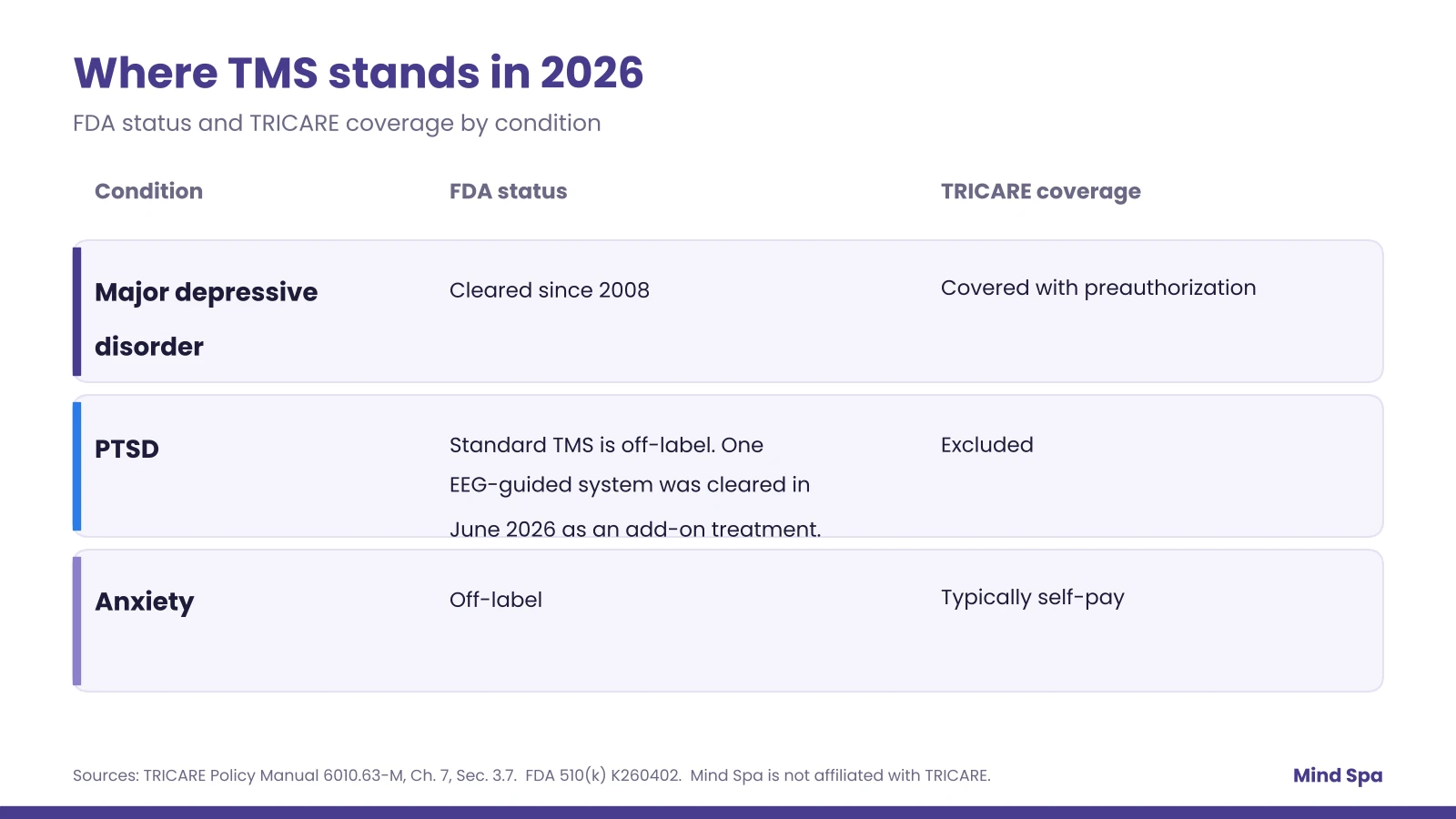
Insurance follows clearance. Colorado sits in the TRICARE West Region, and TRICARE policy covers TMS for major depressive disorder with preauthorization. The same policy lists TMS for PTSD as excluded.4 Most commercial plans draw the line in a similar place.
In practice, PTSD and depression often arrive together. When a person's depression meets a plan's criteria for TMS, the treatment can be covered for the depression. TMS aimed at PTSD or anxiety alone is typically self-pay. Our team checks your benefits and tells you the expected cost before anything starts. Our insurance page has more.
It can be, especially if you have depression alongside PTSD or anxiety and medication has not done enough. It is not a first step. Trauma-focused therapy remains the best-supported treatment for PTSD, and TMS does not replace it.
At Mind Spa, a standard TMS course is 36 sessions, five days a week, for about seven weeks. The most common side effects are scalp discomfort and headache. Seizure is rare, and we screen for that risk before treatment. An evaluation with one of our psychiatric providers is how we work out whether TMS fits your history, or whether something else should come first. You can read more on our TMS therapy page.
Mind Spa is at 5340 S Quebec St Ste 230S, Greenwood Village, CO 80111, just south of Denver with easy access from I-25 and I-225. Patients come to us from across the metro area and from as far as Colorado Springs and Fort Collins. We are open Monday to Friday, 9am to 5pm. Book A Consult or call 303-327-0350.
This article is for education and is not medical advice. TMS for PTSD, anxiety, and traumatic brain injury is off-label on the system Mind Spa uses. Individual results vary and are not guaranteed. Mind Spa is an independent clinic in network with TRICARE West and is not affiliated with or endorsed by TRICARE, the Defense Health Agency, or the Department of Veterans Affairs. Mind Spa is not a crisis service. If you are in crisis, call or text 988 (veterans, press 1).