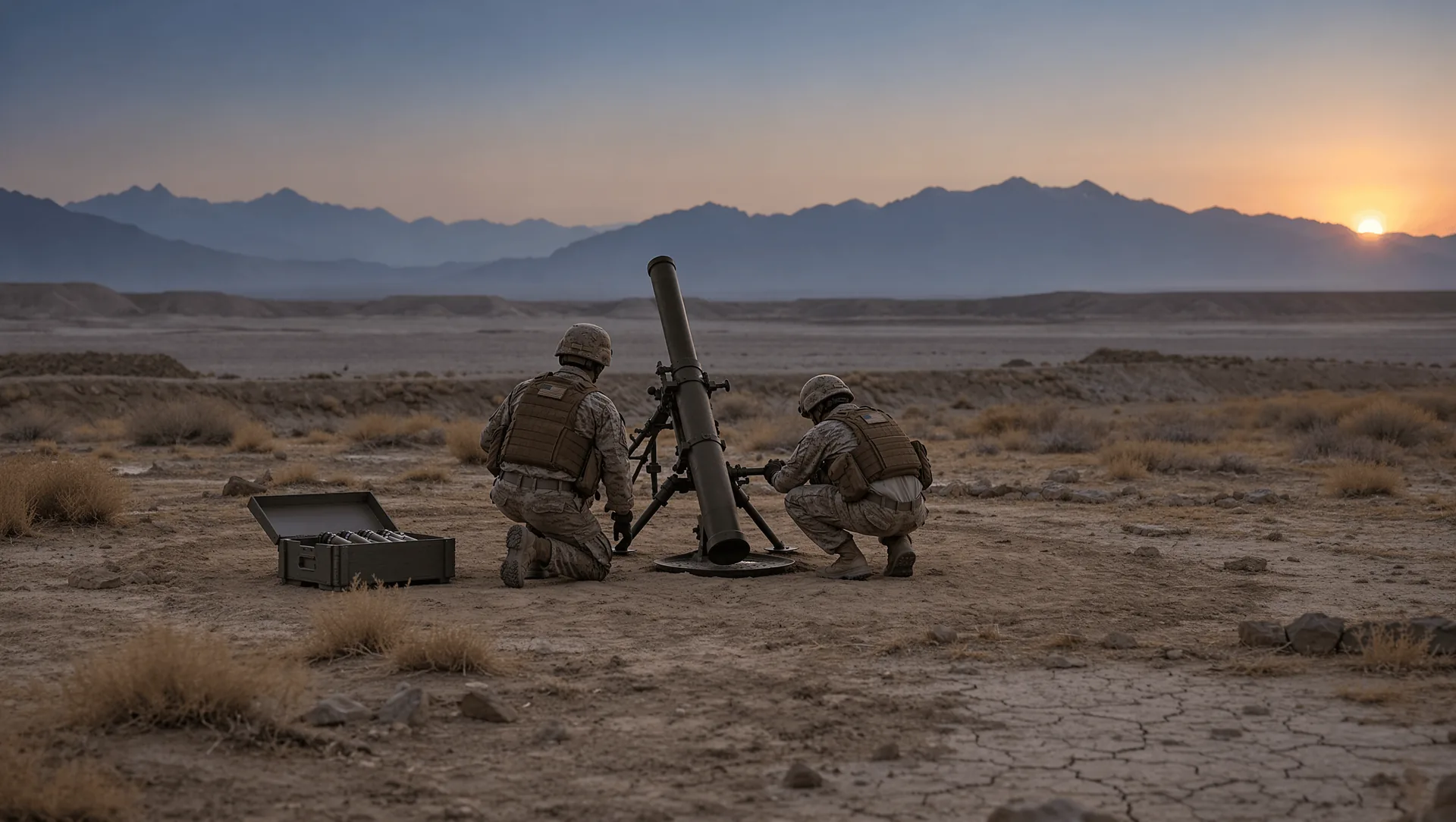
Ask anyone who has spent a day on a mortar line what it feels like afterward. Nobody got hurt. Nobody got knocked down. Every round stayed inside the safety limits. And still, on the drive home, there is a dull headache, a little dizziness, and a brain that seems to be running half a second behind.
For years that was treated as part of the job. If there was no concussion, there was nothing to report. Two recent military studies took the question more seriously, and they found part of the answer in a place few people expected to look: the gut.
Researchers call it low-level blast. It is the pressure wave from your own weapons: mortars, artillery, shoulder-fired rockets, and the explosive charges that breachers use to open doors and walls. One exposure is small. A career can add up to thousands.
Colorado knows this work well. Fort Carson, about an hour south of Denver on I-25, is home to the 4th Infantry Division and the 10th Special Forces Group. Police tactical teams use breaching charges too. Mind Spa's co-founder, Sam Peterson, spent his Army years as an explosive ordnance disposal (EOD) technician, the soldiers who disarm bombs for a living, including tours in Afghanistan. Blast is not an abstract topic in our building.
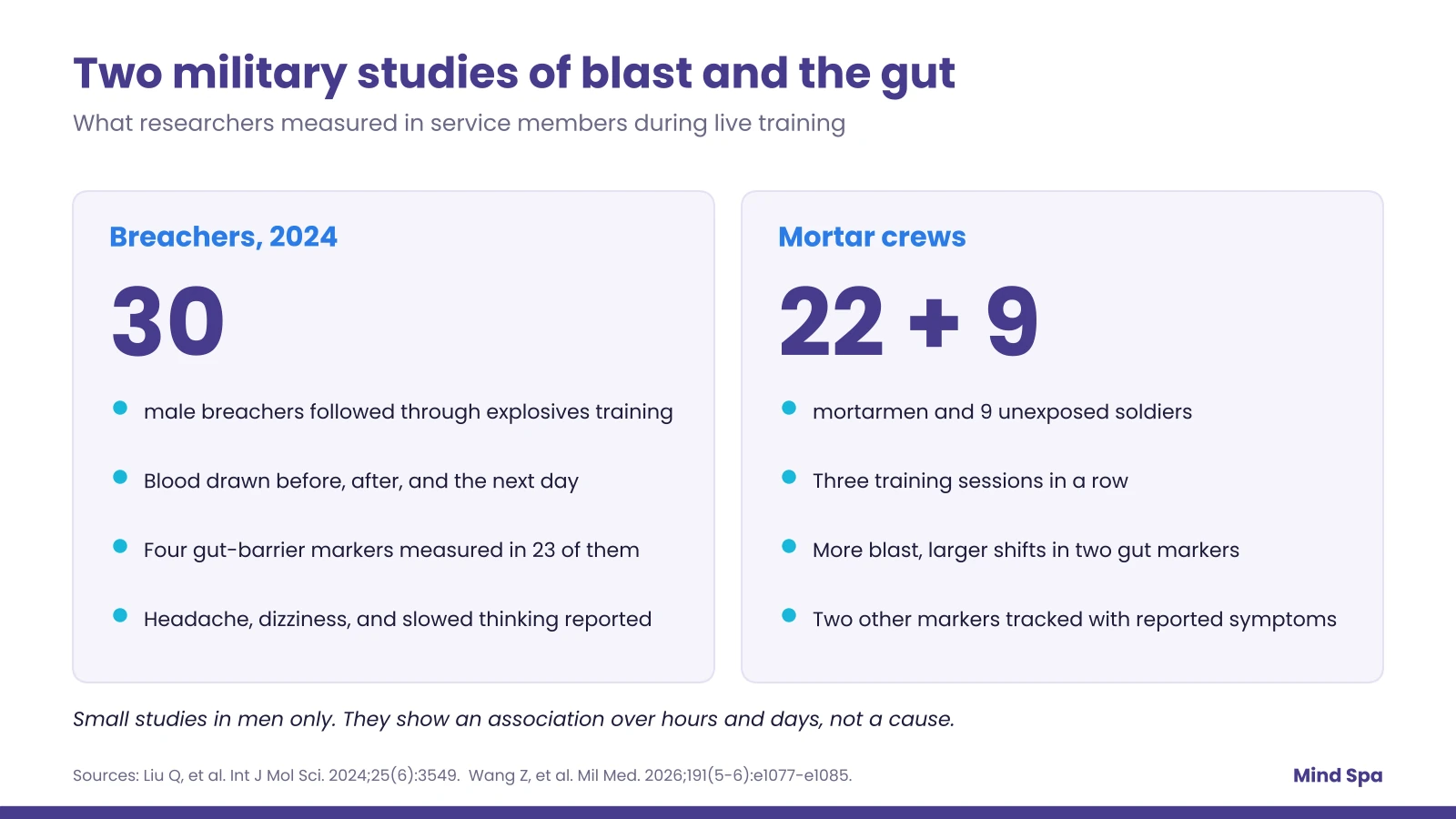
The first study, published in 2024 in the International Journal of Molecular Sciences, followed 30 male breachers through explosives training.1 The team included scientists from the Department of Veterans Affairs research center in Aurora, just up I-225 from us. They drew blood before the blasts, after them, and again the next day, and they asked the men how they felt.
Two things showed up together. The men reported headaches, dizziness, trouble concentrating, and slower thinking. And in their blood, the researchers found shifts in four markers of intestinal permeability, measured in 23 of the participants, along with signs that material from gut bacteria had crossed into the bloodstream.
Intestinal permeability is the term behind the popular phrase "leaky gut." The lining of your intestine is a barrier. It lets nutrients through and keeps bacteria in. When the seams between its cells loosen, things slip through that should not. The four markers the team tracked, zonulin, claudin-3, lipopolysaccharide-binding protein (LBP), and intestinal fatty acid-binding protein (I-FABP), are proteins that rise or fall when that barrier is under strain.
The second study, published in Military Medicine, repeated the idea with a different job.2 It followed 31 service members: 22 mortarmen firing 81mm and 120mm mortars across three training sessions in a row, and 9 soldiers who were not exposed. This time the researchers also measured how much blast each man took. The more blast a mortarman absorbed, the more two of his gut markers moved. Changes in two others, LBP and claudin-3, tracked with the symptoms he reported: taking longer to think, dizziness, and difficulty concentrating. The pattern was stronger in soldiers who already had a history of traumatic brain injury (TBI).
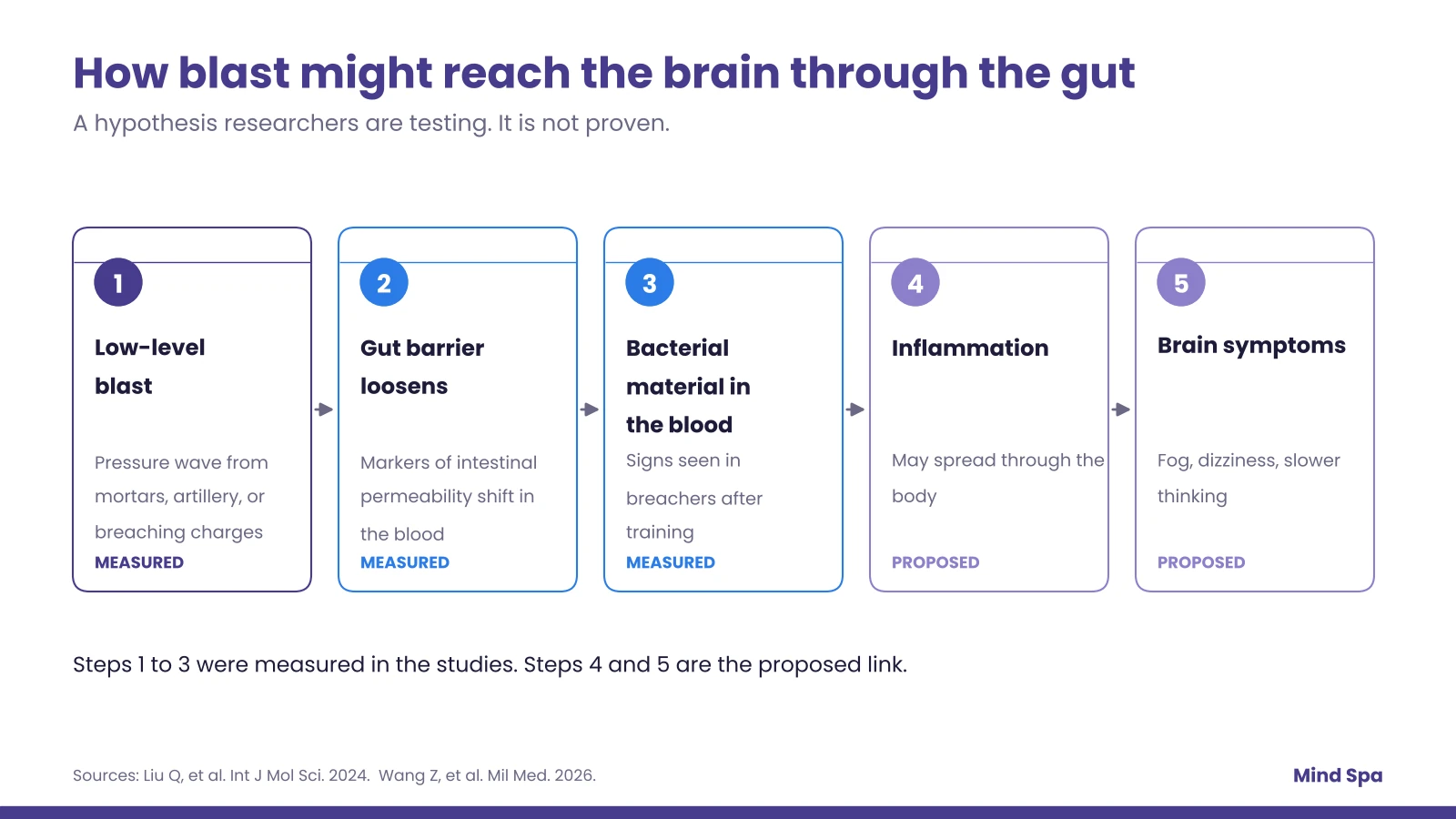
The gut and the brain are in constant contact through nerves, hormones, and the immune system. Scientists call this the gut-brain axis. One idea the researchers raise is that when the gut barrier loosens, bacterial material in the blood can stir up inflammation, and inflammation may add to whatever the blast wave is already doing to the brain.
That is a hypothesis, and the authors treat it as one. What these studies add is a measurable, physical change that shows up in the hours after blast, in the same people who report feeling off.
It is worth being careful here, because this research is easy to oversell.
Both studies were small, and every participant was male. They measured changes over hours and days during training, not over years. They show that gut markers and symptoms moved together. They do not prove that one caused the other. Neither study tested a treatment. And blood tests for gut permeability are research tools right now, not something your doctor can order to diagnose a blast injury.
So no one can yet say that a leaky gut explains the long-term struggles some veterans have with memory, mood, or sleep. What the studies do say is narrower, and still useful: low-level blast leaves a footprint in the body, even on days when nothing seemed to go wrong.
If you carried a mortar tube, fired artillery, worked as a breacher, or served in EOD, three things are worth doing.
For a lot of people, simply hearing that the symptoms have a physical basis is a relief. You were not imagining it.
Mind Spa is an outpatient psychiatry clinic in Greenwood Village. We do not test for gut permeability, and nothing we offer has been studied as a treatment for it. What we do is care for the conditions that often travel with a blast history: depression, post-traumatic stress disorder (PTSD), anxiety, and the lingering effects of TBI.
Care starts with an evaluation that asks about blast and occupational exposure, not only about mood. From there, a licensed psychiatric provider may recommend medication management, talk therapy, transcranial magnetic stimulation (TMS), ketamine infusion therapy, or hyperbaric oxygen therapy (HBOT) in a 2.0 ATA hard-sided chamber. You can read more about care for veterans at Mind Spa.
Mind Spa is at 5340 S Quebec St Ste 230S, Greenwood Village, CO 80111, just south of Denver with easy access from I-25 and I-225. We are open Monday to Friday, 9am to 5pm. Book A Consult or call 303-327-0350.
This article is for education and is not medical advice. Mind Spa uses the Apollo TMS Therapy System, which is FDA-cleared for major depressive disorder and obsessive-compulsive disorder; TMS for PTSD, anxiety, and TBI is off-label. IV ketamine is FDA-approved as an anesthetic; its use for depression, PTSD, and anxiety is off-label. Hyperbaric oxygen therapy is not FDA-cleared for PTSD, TBI, depression, or anxiety, and the hyperbaric chamber at Mind Spa is not an FDA-cleared medical device. Individual results vary and are not guaranteed. Mind Spa is not affiliated with or endorsed by the Department of Veterans Affairs or the Department of Defense. Mind Spa is not a crisis service. If you are in crisis, call or text 988 (veterans, press 1).