In the summer of 2022, a FOX31 Denver news crew set up a camera in a treatment room at Mind Spa in Greenwood Village. The patient in the chair was Sam Peterson, a former Army bomb disposal technician who served in Afghanistan. He is also one of Mind Spa's founders, and he was there for his 35th session of transcranial magnetic stimulation (TMS).
The reporter asked the question most people ask first: what does it feel like?
"I barely feel anything," Sam said. "It's just almost like a little pressure on the outside of my skull."
That short answer takes a lot of the fear out of TMS. The longer answer, what it is, who it is for, and what the research shows, is worth having before you decide.
TMS uses a magnetic coil placed against the scalp to deliver brief pulses to a specific part of the brain. For depression, the usual target is the left dorsolateral prefrontal cortex, an area near the front of the brain that helps regulate mood and tends to be underactive in depression.
It is not surgery, and it is not electroconvulsive therapy. Nothing is implanted. There is no anesthesia and no sedation. You sit in a chair, awake, and when the session ends you can drive yourself back to work or home.
The Food and Drug Administration (FDA) first cleared TMS in 2008 for adults with major depressive disorder who had not improved enough with antidepressant medication. Mind Spa uses the Apollo TMS Therapy System, which is FDA-cleared for major depressive disorder and obsessive-compulsive disorder (OCD).
TMS is not where depression treatment starts. It is for the large group of people who have given medication and therapy a fair try and are still struggling. Clinicians call this treatment-resistant depression, which says more about the treatments tried so far than about the person.
If that sounds familiar, you are in a lot of company, in Denver and everywhere else.
Your first visit is the longest. The team measures your head, finds the treatment spot, and sets the strength of the pulses to your own threshold.
After that, the routine is simple. You sit down, the coil is positioned, and the machine delivers pulses in short bursts. You hear a clicking sound and feel a tapping on your scalp. Some people find the tapping uncomfortable for the first few sessions, and most get used to it.
A standard course at Mind Spa is 36 sessions, five days a week, for about seven weeks. The time commitment is the hardest part for most people. If you are driving up from Castle Rock or Colorado Springs, or down from the north side of the metro area, the daily trip on I-25 is something to plan around honestly.

The clinical trials that led to FDA clearance tested TMS against a sham, a look-alike procedure that delivers no real stimulation. Later research asked a more practical question: what happens in ordinary clinics, with ordinary patients?
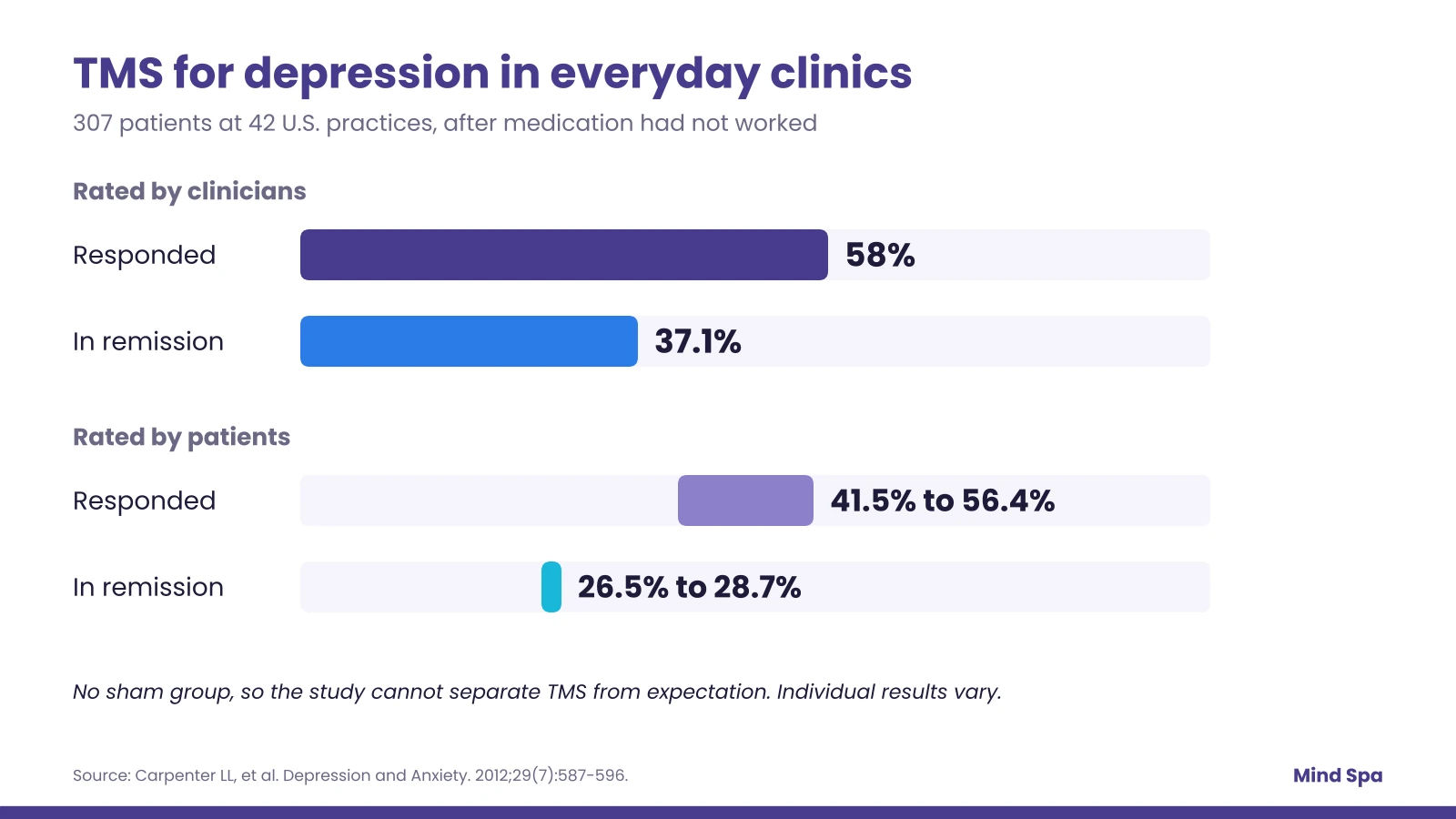
The best-known answer came in 2012. Forty-two TMS practices across the United States tracked 307 patients with major depressive disorder who had not improved with medication.1 On average, they had already been through two and a half adequate antidepressant trials. By the end of treatment, clinicians rated 58 percent of patients as responders, meaning their symptoms had improved substantially, and 37.1 percent as in remission, meaning few or no symptoms remained. When patients rated themselves, the numbers were lower: between 41.5 and 56.4 percent for response, and between 26.5 and 28.7 percent for remission, depending on the questionnaire.
Two cautions belong next to those figures. This study had no sham group, so it cannot separate the effect of TMS from the effect of showing up every day and expecting to feel better. And it means a meaningful share of people did not respond. TMS helps many people with depression. It does not help everyone.
The most common side effects are scalp discomfort and headache, usually mild and usually early in the course. The serious risk is seizure, which is rare. We screen for it before treatment, along with anything metal in or near the head that a magnet could affect.
For major depressive disorder, usually yes, with conditions. Most insurers want to see that medication was tried first.
Colorado is in the TRICARE West Region, managed by TriWest Healthcare Alliance. Its current policy covers TMS for adults 18 and older with severe major depressive disorder who have had an inadequate response to, or could not tolerate, at least two classes of antidepressants. Initial approval is for up to 36 sessions over 90 days, and every course requires preauthorization.2 Commercial plans have their own versions of the same idea.
Mind Spa is in network with TRICARE West, the VA Community Care Network, and major commercial insurers. Our team handles the preauthorization paperwork and reviews your expected costs with you before you begin. See our insurance page or our guide, Does TRICARE cover TMS?
Sam has spoken publicly about living with PTSD, anxiety, and depression after his deployments. He told FOX31 that TMS was helping him. His experience is his own, and yours may be different. TMS for PTSD and anxiety is off-label on the system we use, and Mind Spa has changed TMS equipment since that segment was filmed.
What has not changed is the reason he agreed to be filmed. It is easier to walk into a treatment room once you have seen someone else sit in the chair.
If you are wondering whether TMS fits your situation, an evaluation is where that gets decided. You can learn more on our TMS therapy page.
Mind Spa is at 5340 S Quebec St Ste 230S, Greenwood Village, CO 80111, just south of Denver with easy access from I-25 and I-225. We are open Monday to Friday, 9am to 5pm. Book A Consult or call 303-327-0350.
This article is for education and is not medical advice. Individual results vary and are not guaranteed. Mind Spa is an independent clinic in network with TRICARE West and is not affiliated with or endorsed by TRICARE, the Defense Health Agency, or the Department of Veterans Affairs. Mind Spa is not a crisis service. If you are in crisis, call or text 988 (veterans, press 1).