Anyone who has spent a summer along the Front Range knows the pattern. The morning is clear. Around two o'clock the clouds stack up over the foothills, the sky goes dark, and for an hour it looks like the day is ruined. Then the storm moves out over the plains, and by dinner the light is back.
Most hard days work the same way. This article is about the times they do not.
Everyone has stretches when things go wrong. A job ends. A diagnosis comes back. A marriage strains, a car gets totaled on I-25, a kid is struggling and you cannot fix it. Stress piles up until you lie in bed in the morning wondering how you will get through the day.
Feeling sad, angry, or afraid in those moments is not a malfunction. Sadness follows loss. Anger shows up when a line gets crossed. Fear tells you something you care about is at risk. These emotions are signals, and they usually point toward something you can do: make the call, ask for help, rest, try again.
The weather passes. You may not feel great, but you can see that the storm has an edge.
Depression is different in kind, not only in degree. People who live with it often say the worst part is not the sadness. It is the sense that there is no edge to the storm, that this is simply how things are now.
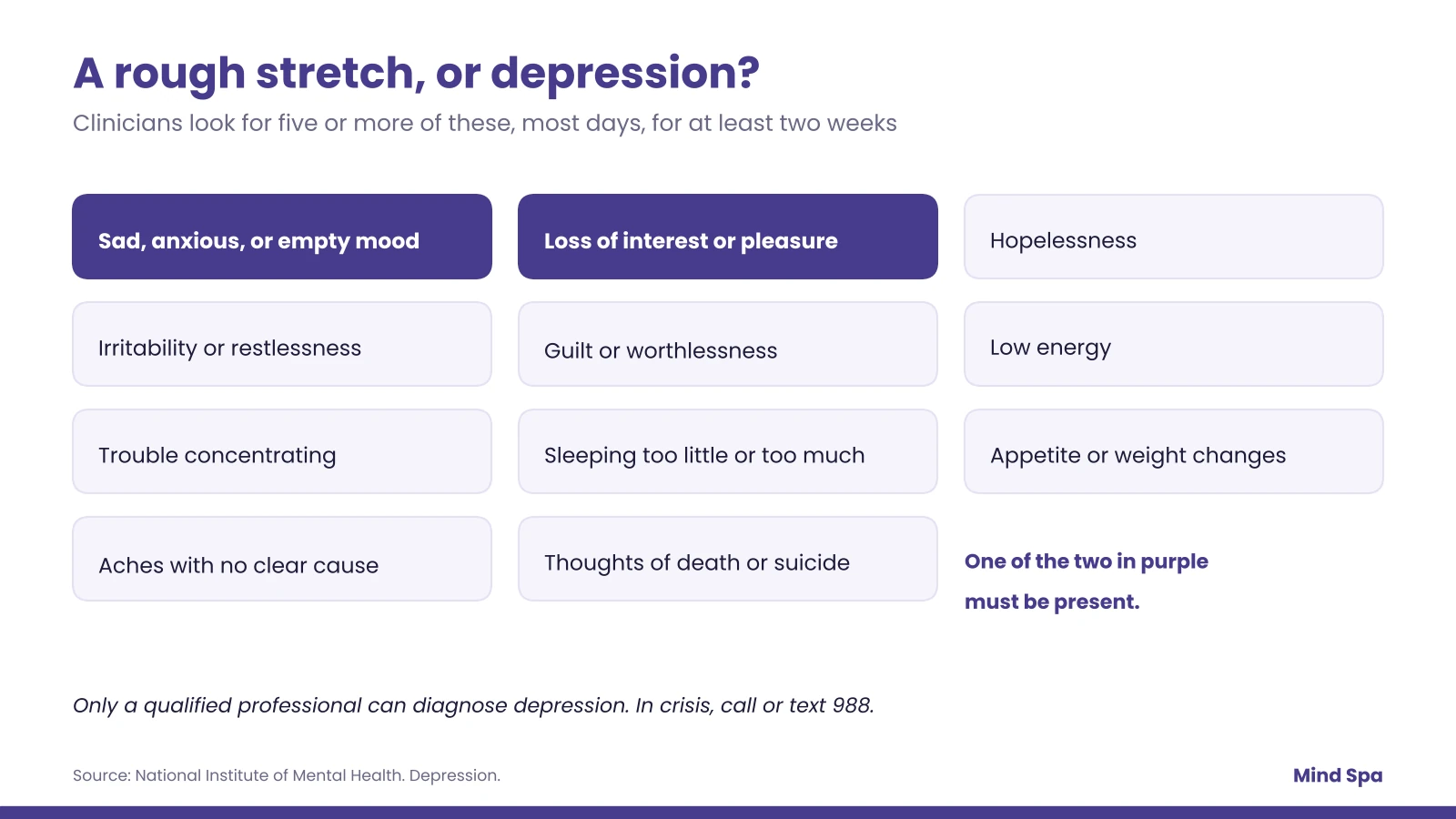
Major depressive disorder, also called clinical depression, is a medical condition. It is diagnosed when symptoms last most of the day, nearly every day, for at least two weeks, and get in the way of work, relationships, or daily life. The National Institute of Mental Health lists these common symptoms:1
A diagnosis generally requires at least five of these, and one of them must be either depressed mood or loss of interest. Only a qualified professional can make that call, partly because thyroid problems, some medications, and other medical conditions can look like depression.
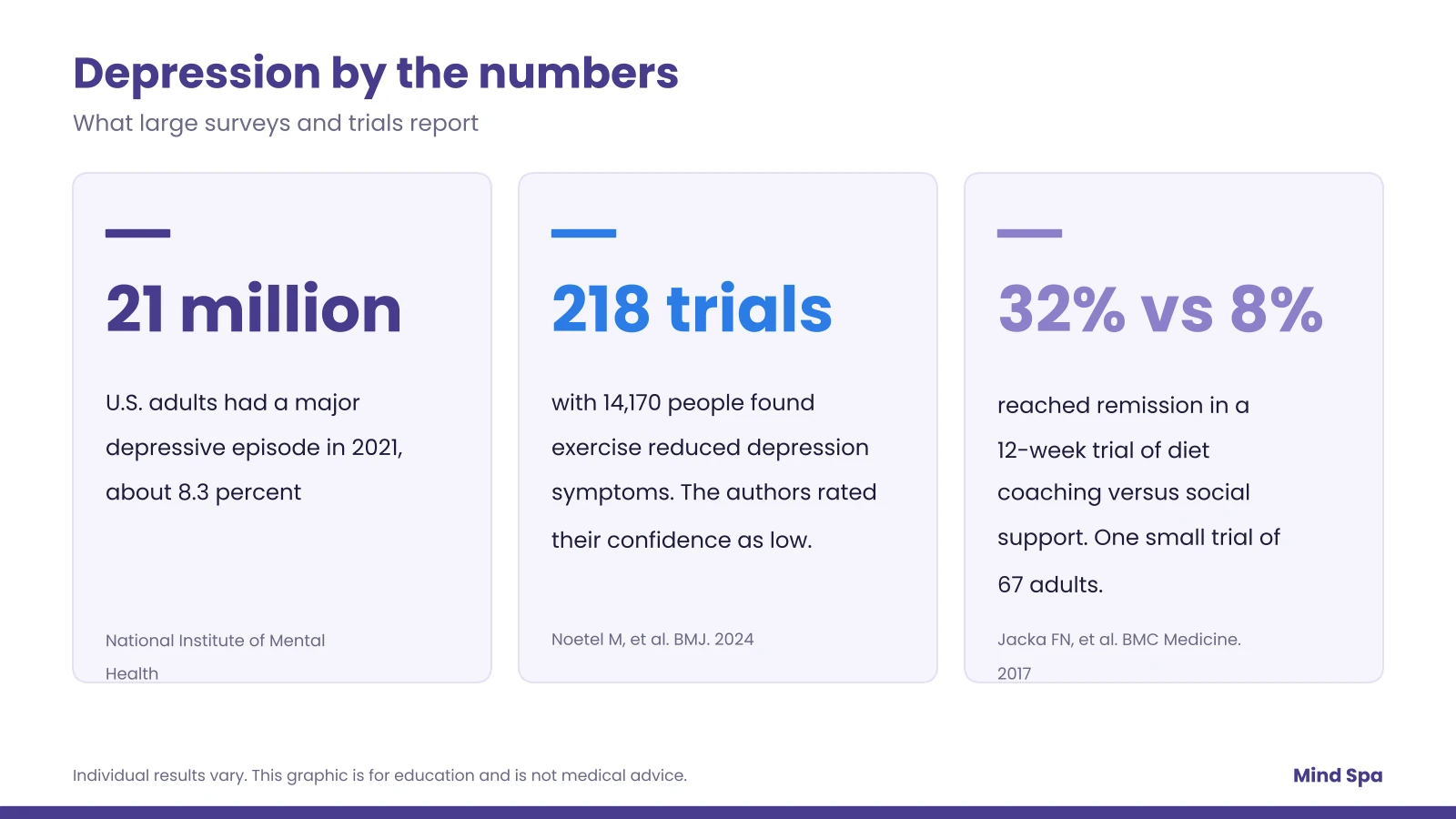
It is also common. In 2021, an estimated 21 million adults in the United States, about 8.3 percent, had at least one major depressive episode.2
There is rarely one cause. Research points to a mix of factors that stack on top of each other:1
None of these is a character flaw. Depression is not what happens to people who do not try hard enough.
Here is the hopeful part, and it is not wishful thinking. The American Psychiatric Association describes depression as among the most treatable of mental disorders.3 Treatable does not mean quick, and it does not mean the first thing you try will work. It means that for most people, something does.
Talk therapy. Two approaches have the longest track record. Cognitive behavioral therapy (CBT) teaches you to notice and change the thought patterns and habits that keep depression going. Interpersonal therapy focuses on the relationships and life changes tangled up with your mood. Many people see meaningful improvement in 10 to 15 sessions.3
Medication. Antidepressants act on the brain chemistry involved in depression. They take time, often several weeks to reach full effect, and finding the right one can take more than one attempt. Never stop a medication suddenly or on your own. Work with your prescriber.
Movement. A 2024 analysis in The BMJ pooled 218 trials with 14,170 participants and found that exercise reduced symptoms of depression, with walking or jogging, yoga, and strength training showing the largest effects.4 The authors rated their confidence in the evidence as low, because many of the trials were small or imperfect. Still, a walk is hard to argue with. Near our clinic that might be a stretch of the High Line Canal Trail or a loop at Cherry Creek State Park.
Food. In a 2017 Australian trial, 67 adults with depression received either coaching on a Mediterranean-style diet or social support for 12 weeks, in addition to their usual care. About 32 percent of the diet group reached remission, compared with 8 percent of the comparison group.5 It was a single small trial, so treat it as a reason to eat well, not a prescription.
Sleep and light. Depression and poor sleep feed each other. A steady wake time and morning daylight both help. Light matters more than people expect: at the winter solstice, Denver gets less than nine and a half hours of daylight. For winter-pattern depression, known as seasonal affective disorder, light therapy with a special lamp is a standard treatment.6
Connection. Depression pushes people to withdraw, and withdrawal makes it worse. A friend, a faith community, a veterans' group, a standing coffee on Saturday: any regular contact counts.
When the first steps are not enough. Some depression does not lift with therapy and medication alone. That is called treatment-resistant depression, and there are options built for it:
If your mood has been low for more than two weeks, or it is getting in the way of work, family, or the things you care about, talk to a doctor or mental health professional. You do not have to be sure it is depression. That is their job to sort out.
If you are thinking about suicide or hurting yourself, call or text 988, the Suicide and Crisis Lifeline, right now. Veterans can press 1. If you are in immediate danger, call 911.
Mind Spa is an outpatient psychiatry clinic in Greenwood Village serving the Denver area. A first visit is a 90-minute, in-person psychiatric evaluation with one of our prescribers. From there, your plan may include medication management, talk therapy, TMS, or other options, depending on what you have already tried and what you want. You can read more about depression care at Mind Spa.
Mind Spa is at 5340 S Quebec St Ste 230S, Greenwood Village, CO 80111, just south of Denver with easy access from I-25 and I-225. We are open Monday to Friday, 9am to 5pm. Book A Consult or call 303-327-0350.
This article is for education and is not medical advice. Treatment decisions are made by a licensed psychiatric provider after an evaluation. Mind Spa uses the Apollo TMS Therapy System, which is FDA-cleared for major depressive disorder and obsessive-compulsive disorder. Individual results vary and are not guaranteed. Mind Spa is not a crisis service. If you are in crisis, call or text 988 (veterans, press 1).